
When One AWS Region Sneezes, the Internet Catches a Cold
How to tier your systems, design replayable data paths, and keep user workflows alive even when a cloud region fails.
By Rev.AISomething Team
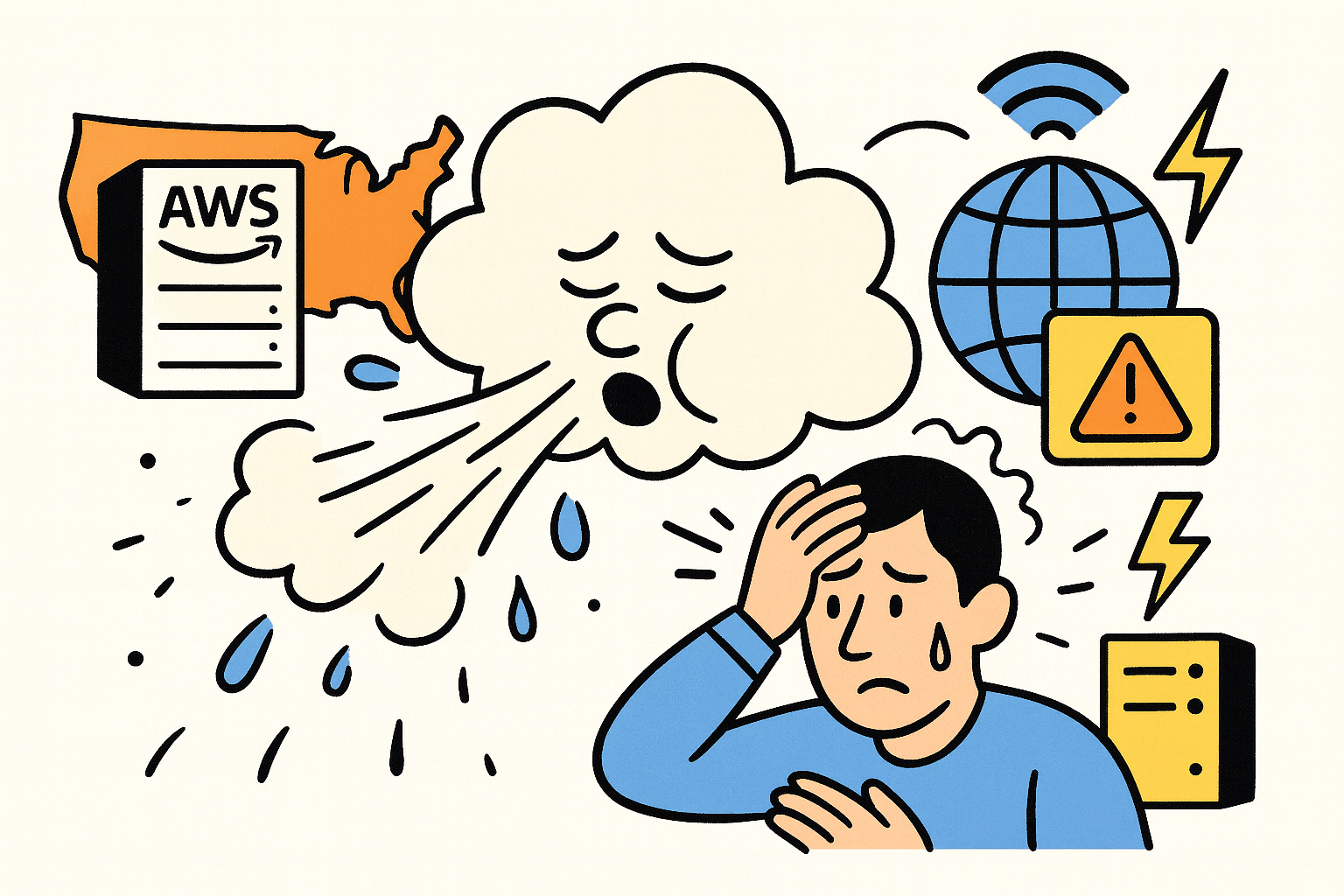
Every time an AWS region hiccups, the internet ripples: auth providers throttle, queues back up, DNS flaps, and dashboards light up with noise you can’t trust. The blast radius is wider than the status page suggests because most stacks lean on region-scoped dependencies wired together with hopeful assumptions. This is a pragmatic guide to shrinking that blast radius—and why Rev.AISomething is doubling down on local-first, self-reliant architecture that keeps shipping even when the cloud stumbles.
Rev.AISomething’s playbook is simple: your platform should work for you, not the other way around. That means designing an operating model where the business keeps moving even if a hyperscaler catches a cold, and where a hybrid mix of cloud speed plus local control gives you real options when the unexpected happens.
What Keeps Breaking
The modern SaaS supply chain is a lattice of tightly coupled services. When one piece goes sideways, everything shakes.
- Regional chokepoints cascade. Authentication, storage, message queues, DNS, and control planes frequently cohabitate the same region. Lose that region and the entire app seizes.
- “Multi-AZ” is not multi-region. High availability inside one region does nothing when the whole region blinks. Most teams stop at multi-AZ and call it done.
- Hidden single points of failure stay hidden. CI/CD, secrets managers, feature flag providers, and observability backends are often hard-pinned to one region or vendor. They’re the silent dependencies that snap first.
Why Even Big Companies Still Take the Hit
Massive orgs with hundreds of engineers aren’t immune. The incentives are skewed, the complexity is real, and SLAs don’t bend to wishful thinking.
- Incentives reward speed over resilience. Shipping features faster and shaving cloud spend looks great until the postmortem. Multi-region readiness never feels urgent—until it is.
- Complexity is a tax few pay. Active-active multi-region stacks demand replayable writes, disciplined testing, and realistic chaos drills. Most teams under-invest in runbooks and never practice failover.
- SLAs create a mirage. Business uptime targets routinely exceed a cloud provider’s regional SLA envelope. Hope and dashboards aren’t architecture.
What Actually Works: Choose Lanes, Don’t Boil the Ocean
Trying to harden everything at once guarantees you ship nothing. Pick lanes.
- Tier your system.
- Tier-0 (cannot be down): Active-active multi-region footprint, idempotent commands, tested traffic steering.
- Tier-1 (short blips allowed): Active-passive with automated failover (DNS, anycast) and rehearsed RPO/RTO targets.
- Tier-2 (best effort): Single-region, multi-AZ with acknowledged downtime and fast restore plans.
- Data strategy first.
Decide consistency per domain: synchronous paths for the operations that truly need immediacy, asynchronous everywhere else. Treat writes as events you can replay and make every consumer idempotent by design. - Operational truth.
Infrastructure as Code everything. Detect drift automatically. Run game-days that hard-block a region and force a deploy through the failure. Build golden paths for incident comms, traffic steering, and data promotion so people practice before production demands it. - Balance cloud acceleration with local control.
Keep a warm standby outside the primary cloud footprint—be that a co-lo rack, an on-prem cluster, or a secondary provider. Teams that kept a lightweight local data center or alternate cloud ready to absorb traffic avoided being completely dark during recent AWS events because they could fail workloads over while the rest of the world waited.
The Punchline
We don’t win by renting more reliability from someone else’s SLA. We win by owning the critical path, making the client sovereign, and treating the cloud as a replaceable accelerator. That’s the Rev.AISomething way: design for independence, minimize external dependence, and ship software that stays up even when the internet doesn’t.